


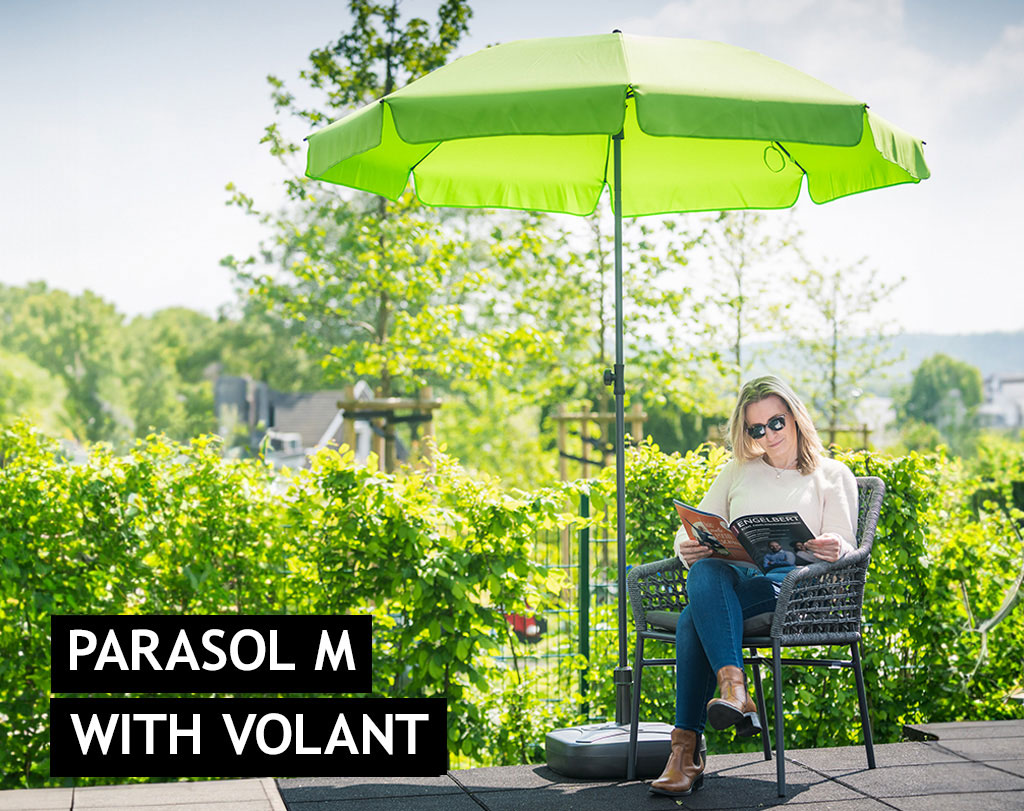
A parasol on a tennis court is far more than just a luxury extra. On open courts with no natural shade, players, spectators and officials are exposed to direct sunlight for hours on end. In summer in particular, this can be not only unpleasant but also a health hazard.
Many tennis clubs are therefore faced with the question: which parasol is really suitable for use on a tennis court? Standard garden parasols quickly reach their limits here – whether due to a lack of wind resistance, insufficient size or a lack of mounting options.
This guide shows you what to look for in a parasol for a tennis court, what requirements tennis clubs should take into account, and how functional sun protection can be effectively integrated into the club’s day-to-day operations.
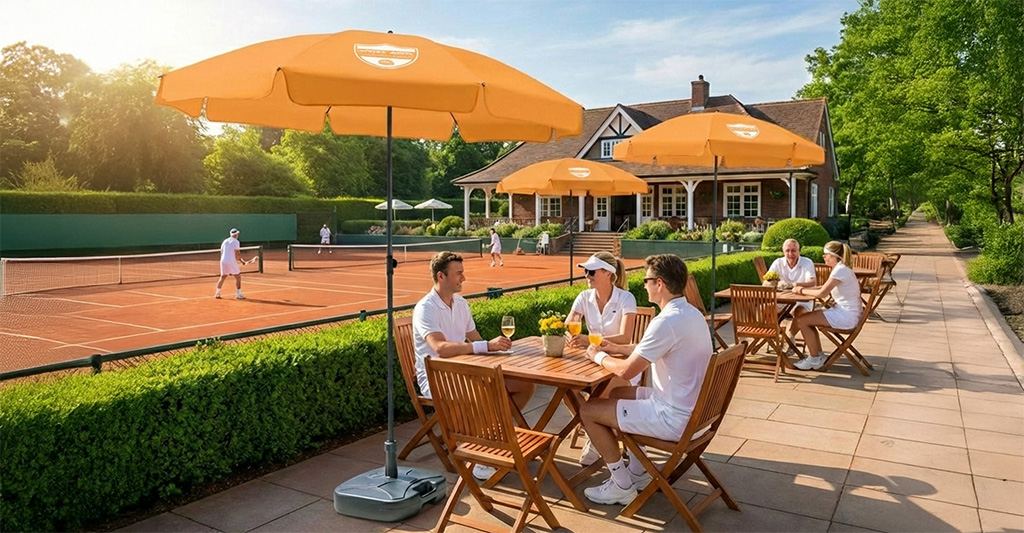
Table of Contents
- Why a special parasol is needed on the tennis court
- Requirements for a parasol for a tennis court
- The correct size and positioning on the tennis court
- Typical areas of use at the tennis centre
- Fixing and safety: What clubs should bear in mind
- Parasols as advertising space at the tennis club
- Common mistakes when buying parasols for tennis courts
- Conclusion: How tennis clubs can find the right parasol
- Frequently Asked Questions (FAQ) about the parasol on the tennis court
Why a special parasol is needed on the tennis court
Tennis courts are among the sports facilities with the highest levels of sun exposure. The courts are open-air, matches often last a long time, and breaks are spent right at the edge of the court. Player benches, umpire’s chairs and spectator areas, in particular, are often left unprotected.
A tennis court parasol must therefore be capable of much more than a conventional garden umbrella:
- It is constantly exposed to the wind
- It is used by many people
- It must be securely fixed in place
- It should function reliably for years to come
For tennis clubs, the duty to ensure public safety is also a key consideration. Parasols that topple over or are damaged can quickly become a safety hazard.
A parasol specifically designed for sports facilities is therefore not a luxury, but a sensible investment.
Requirements for a parasol for a tennis court
Wind resistance and construction
Open-air tennis courts often experience strong wind turbulence. A parasol on a tennis court should therefore:
- have a robust steel frame
- feature reinforced struts
- be designed for long-term outdoor use
Wind-resistant parasols not only extend the lifespan of the equipment but also enhance safety on the court.
UV protection and fabric quality
A high-quality parasol for a tennis court should:
- offer UV protection of at least UPF 50+
- be made of thick, tear-resistant material
- be colourfast and weather-resistant
Quality pays off in the long run, particularly at busy tennis centres.
Practicality for everyday use in club operations
In day-to-day club life, parasols must:
- be easy to open and close
- require little maintenance
- be available to reorder when needed
A parasol for a tennis club should therefore always be assessed from a practical point of view.
The correct size and positioning on the tennis court
The right size depends very much on where it will be used. For tennis clubs, the rule of thumb is:
- Players’ benches: minimum Ø 1.80 m
- Spectator areas: larger spans depending on the number of seats
- Tournament courts: ample shade for longer stays
Correct positioning is also important. The parasol should be positioned so that it:
- provides effective shade during peak playing times
- does not obstruct sightlines or walkways
- can adapt flexibly to the position of the sun
Terms such as ‘tennis player’s bench parasol’ or ‘tennis court spectator parasol’ play a key role here.
Typical areas of use at the tennis centre
A professional parasol for a tennis court is used in a wide variety of areas to optimise conditions for both players and spectators:
• Players’ benches:
Essential protection during half-time to help keep the players’ body temperature robust.
• Referee’s chair:
Enables staff to work without being distracted by glare and protects official staff from direct midday sun.
• Spectator areas:
Ensures that guests stay for longer and enjoy a much more comfortable experience at Meden matches or tournaments.
• Tournaments & Events:
It creates a professional image and often serves as a central information point or meeting place.
• Club Terrace:
The perfect combination of sporting activities and catering, allowing you to round off the day at the club in a relaxed atmosphere.
Tip: Anyone looking for a long-lasting solution here often opts for a professional parasol solution designed specifically for tennis clubs.
Fixing and safety – what clubs should bear in mind
Choosing the right fixing method is a crucial factor in ensuring safety on the installation site and the longevity of the umbrella:
- High-quality umbrella stands are essential for this application.
- The surface (sand, paving, concrete) must be taken into account
A professionally installed parasol on the tennis court reduces the risk of accidents and ensures it remains safe to use in the long term.
Parasols as advertising space at the tennis club
As well as their purely functional purpose of providing shade, parasols on tennis courts offer enormous potential for club funding. Compared with traditional perimeter advertising, they offer significant advantages:
Why sponsors love parasols
- Direct visibility: The umbrellas are often positioned right next to the players or spectators and are therefore constantly in view.
- Positive association: The sponsor is perceived as a ‘patron’, ensuring comfort and well-being.
- Customisable design: Logos, club colours or slogans can be displayed prominently and in high quality on the panels or the volant.
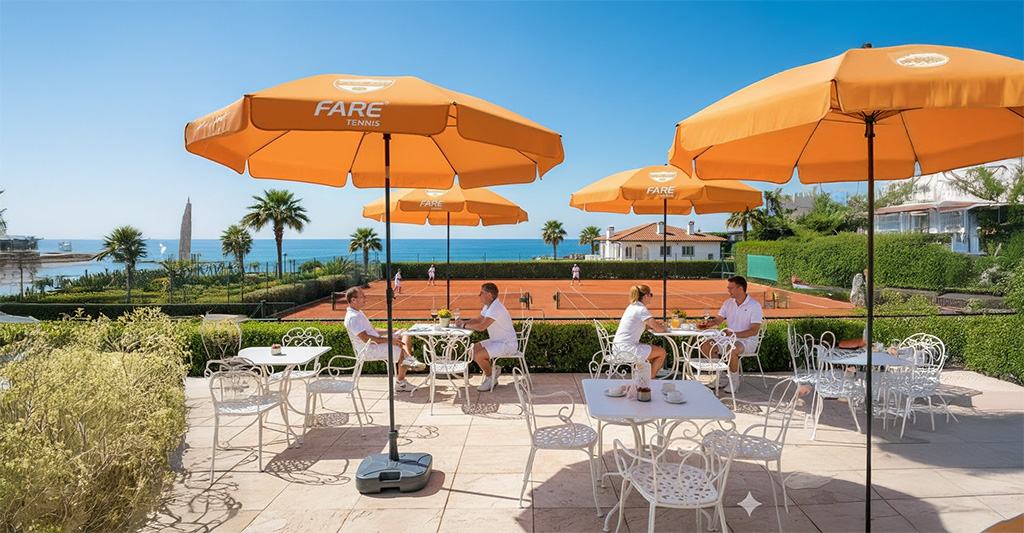
Looking for a long-lasting solution? Those who prioritise quality often opt for a professional parasol solution that is specifically tailored to the requirements of tennis clubs and their sponsors.
Common mistakes when buying a parasol for a tennis court
Avoid these common mistakes to prevent your club from making poor purchases and incurring unnecessary follow-up costs:
Cheap garden parasols are not designed to withstand prolonged exposure to UV rays and the wind conditions found at open-air sports facilities. They often need replacing after just one season.
If the pole is too light or the frame is unstable, umbrellas may tip over or be damaged in gusts of wind.
Not all shade protects against UV radiation. Without certified UPF 50+ protection, players and spectators risk getting sunburnt even in the shade.
Conclusion: Quality pays off
A high-quality parasol on the tennis court is an investment that goes far beyond simply providing shade. It protects the health of members, enhances safety on the premises and, through professional sponsorship, even provides a source of income for the club.
When making a purchase, pay particular attention to the following:
- > Maximum wind resistance and robust aluminium construction
- > Certified UV protection (UPF 50+) for active skin protection
We’ve put together the perfect bundles for you!
Equip your club professionally now and ensure the best possible conditions both on and off the pitch.